A graduate from Michael Okpara University of Agriculture, Umudike (MOUAU), Miss Joy Mamkwe, has shared her journey of developing a sustainable, re-usable sanitary pad made from banana trunks.
A Biochemistry graduate, Mamkwe hails from the Bende Local Government Area in Abia State and spoke exclusively with Vanguard about her innovation.
She emphasized that the product is fully locally made, with raw materials sourced from banana trunks, which are abundant in Southern Nigeria, particularly in her home state of Abia.
Explaining how the idea came about, Mamkwe said, “I’m a Biochemist, and I love researching. Initially, I was working on renewable energy, but along the line, I came across some waste materials in Nigeria that could be turned into something useful. And that’s banana trunks, which we have in abundance here in Abia State.”
She further explained that Nigeria is the largest producer of bananas in West Africa, but the banana trunks often go to waste. “The truck goes into waste whereas it could be used in the production of books and textile materials.”
Through her research, Mamkwe discovered that banana trunks could be used to produce re-usable sanitary pads. She began the project in 2022 during her final year at university, and after completing her NYSC service in 2024, she moved on to small-scale production.
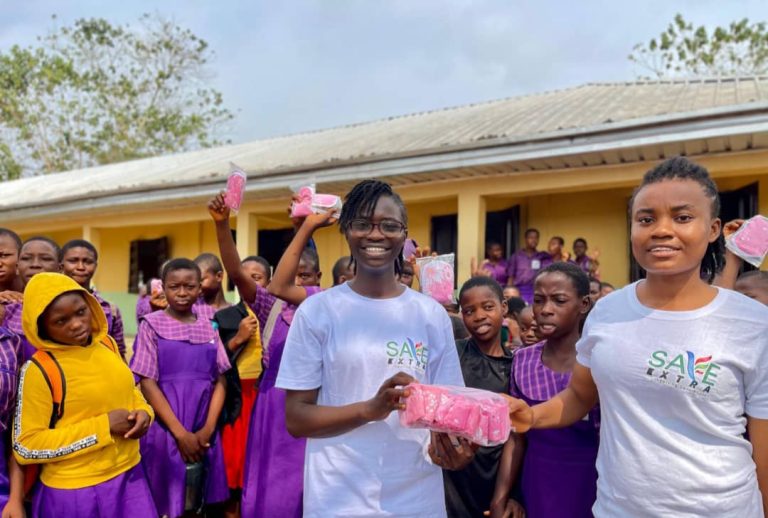
Regarding hygiene concerns, she assured that the raw materials undergo a thorough sterilization process in a hygienic environment to ensure they are safe for use.
“We ensure proper hygiene and follow all the processes of production. After the extraction of the raw materials from banana trunks, we subject it to thorough sterilization process including cooking. The final sterilization process is the UV-light to ensure it’s safe for human use.”
When asked about certification from the National Agency for Food and Drug Administration and Control (NAFDAC), Mamkwe confirmed that the agency had provided her with registration conditions. “Recently, I was with NAFDAC for registration, and they gave us the conditions and the list of things to put in place including a befitting production factory.”
Mamkwe revealed that she is in the process of acquiring NAFDAC certification but requires financial support to secure a 5-room factory, a key requirement by the agency. She currently produces her product on the university campus but is working toward establishing an external facility.
“For us to set up a standard production factory, we need millions of Naira, and my major challenge is how to raise the fund,” she said.
However, she noted that with about N1.5 million, she could rent an apartment and procure additional equipment to expand production.
An investor had shown interest in her innovation, but Mamkwe was cautious. “Recently, I got an investor who saw prospect in my innovation, and wanted to invest in it but wants to be made a co-founder. I was scared, and my mentor advised against that. I was advised against accepting any investor that wants to be made a co-founder instead of just securing some percentage of equity in the business.”

Mamkwe shared that she has started receiving orders from various organizations interested in distributing the sanitary pads to students. “We are getting orders from some organizations who procure our products for free distribution to students. But we need some funds to scale up and meet demands.”
Her product is particularly aimed at low-income earners, including students, rural girls, and peasant farmers who cannot afford expensive, non-reusable sanitary pads. “High cost of sanitary pads has made it very difficult for low-income earners. So, my product has become a succour for them especially students, poor rural girls and peasant farmers who can’t afford that.”
Currently, in Nigeria, sanitary pads are sold at prices ranging between N800 and N1,500 for a pack of 10, making Mamkwe’s innovation an affordable alternative.
Looking ahead, Mamkwe intends to pursue a master’s degree in Public Health, as she aims to improve women’s health through her work. “I studied Biochemistry but because of this project, I want to go for Masters in Public Health so I can stand a better chance to function well in women’s health generally. I have already undergone some business classes.”
The Commissioner for Small and Medium Enterprises in Abia State, Mr. Mike Akpara, has expressed enthusiasm for the innovation.
He encouraged Mamkwe to formally write to the Ministry, stating her needs, and assured that the Ministry would support her after reviewing her project.
He added, “Let her do us a letter and come to demonstrate what she has invented, and we will look at it, and help push it to the Governor. She might get a favourable response. Everything is on the table. Let her come so we may see what she has done.”
Professor Mabel Onwuka, Director of the Centre for Gender Youth and Child Development at MOUAU, praised Mamkwe for her invention, which she believes will ease the financial burden on girls, particularly students, who struggle with the cost of sanitary products.
“The university women procured some quantity of the re-usable sanitary pads which they distributed to school girls and rural women during this year’s international women’s day celebration.”
Professor Onwuka also expressed support for innovative female students and pledged continued backing for Mamkwe’s endeavors.