By Segun Adeyanju
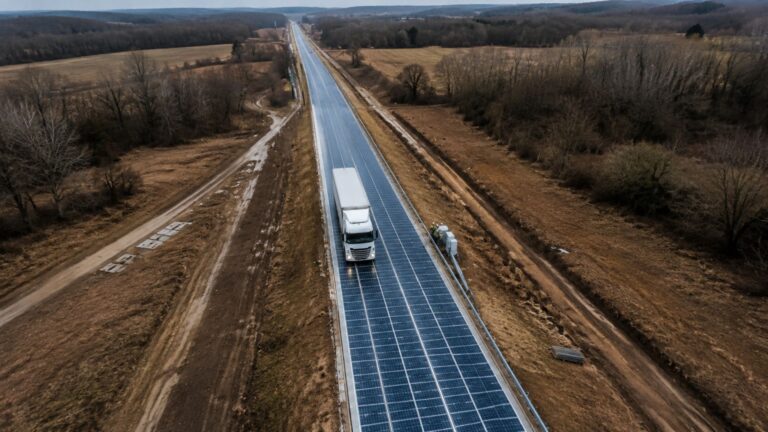
Several countries, including the United States, France, Germany, and Switzerland, are exploring a futuristic transport concept that could redefine road infrastructure, highways made with solar energy-generating surfaces capable of supporting heavy traffic while producing electricity.
The idea involves replacing or overlaying traditional asphalt with reinforced photovoltaic panels designed to withstand the weight of vehicles, including heavy-duty trucks, while converting sunlight into usable electrical power for nearby communities and infrastructure.
Reports indicate that pilot projects and experimental installations are being tested in parts of Europe and North America as governments and research institutions explore ways to integrate renewable energy generation into existing transport networks.
According to research summaries, similar solar road technologies have already been trialed in countries like France and the Netherlands, where roads, bike lanes, and sidewalks were fitted with solar modules to test durability and energy output.
However, earlier experiments revealed major challenges, including high costs, wear from traffic, and lower-than-expected efficiency compared to conventional rooftop solar systems.
Despite these limitations, new versions of the technology are being designed with stronger “armored” surfaces, improved heat resistance, and smarter energy systems that aim to make roads both functional and productive energy assets.
Supporters of the concept say that just one kilometer of solar highway could potentially generate enough electricity to power residential neighborhoods, street lighting, and even support electric vehicle infrastructure if scaled effectively.
Critics, however, remain cautious, arguing that while the idea is innovative, conventional solar farms and rooftop panels still deliver better performance at lower cost and with easier maintenance.
Still, governments involved in ongoing trials say the goal is not immediate replacement of asphalt, but long-term experimentation to determine whether roads can become dual-purpose infrastructure, transport corridors and clean energy generators at the same time.
If successful, the technology could mark a major shift in how cities think about energy production, turning everyday highways into intelligent, electricity-generating systems embedded directly into transport networks.