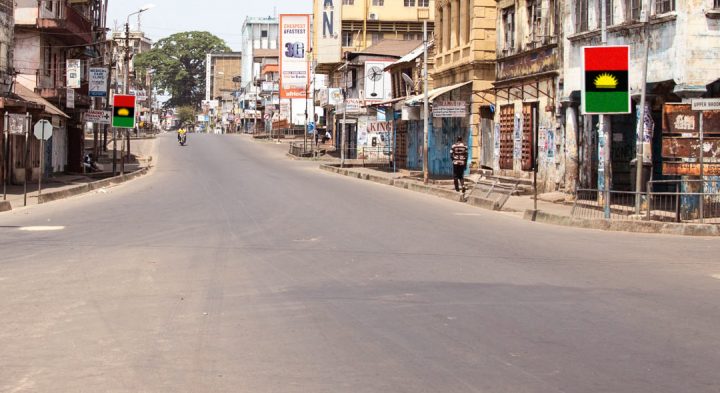
A new report by SBM Intelligence has revealed that the South-East region of Nigeria has lost a staggering ₦7.6 trillion over a span of four years due to the prolonged sit-at-home order initially championed by the Indigenous People of Biafra (IPOB).
The report, titled “Four Years of Disruption,” outlines the economic, social, and humanitarian toll of the Monday lockdowns, which have paralysed commerce and endangered lives since 2021.
What began as a symbolic protest demanding the release of IPOB leader, Nnamdi Kanu, has since evolved into a protracted regional crisis, marked by violence, fear, and economic hardship. In states like Abia, Anambra, Ebonyi, Enugu, and Imo, Mondays are now associated not with the start of a productive workweek but with eerie silence, shuttered businesses, and looming threats.
“The sit-at-home protests, enforced by IPOB since 2021, have transformed from a symbolic act of dissent into a protracted crisis with devastating socioeconomic and security consequences for Southeast Nigeria,” the report stated.
Economic Devastation and Lost Livelihoods
According to SBM Intelligence, the weekly shutdowns have inflicted severe damage across key sectors, particularly for small and medium-sized enterprises (SMEs) and the transport industry. The report estimates that **micro and small businesses lose approximately ₦4.6 trillion annually**, while **transport companies face losses ranging from ₦10 billion to ₦13 billion every Monday**.
The Onitsha Main Market, regarded as one of the largest in Africa, has been heavily affected, with repeated closures resulting in missed trade opportunities and economic hardship for thousands of traders and customers alike.
Human Cost and Rising Insecurity
Beyond financial loss, the crisis has claimed **776 lives** and recorded **332 violent incidents** from 2021 to 2025, with **Imo and Anambra states** bearing the brunt of the violence. The report implicates IPOB’s armed wing, the **Eastern Security Network (ESN)**, and other criminal factions in orchestrating attacks that enforce the lockdown, ranging from arson and kidnapping to targeted killings.
Public Support Wanes Amid Violence
Originally rooted in protests against the perceived marginalisation of the Igbo people and the incarceration of Nnamdi Kanu, the sit-at-home movement has largely lost public sympathy due to internal divisions, growing lawlessness, and the devastating impact on everyday life.
“The movement has been hijacked by violence, criminality, and internal fragmentation, eroding public support and deepening instability,” SBM noted.
Attempts at Government Intervention
Despite the deepening crisis, some state governments have pushed back. Enugu State, under the leadership of Governor Peter Mbah, took a firm stance by penalising individuals and institutions that comply with the Monday sit-at-home orders. This policy shift has reportedly helped restore some level of normalcy in parts of the state.
Security forces have also intensified operations in affected areas, although their efforts have yielded mixed results due to the complex and often violent nature of the conflict.
The Bigger Picture
The SBM report paints a grim picture of how a regional protest turned into an enduring crisis, highlighting the urgent need for both **political dialogue** and **grassroots interventions**. It calls for a concerted effort by the federal and state governments, community leaders, and civil society organisations to restore peace, rebuild trust, and revive economic life in the South-East.