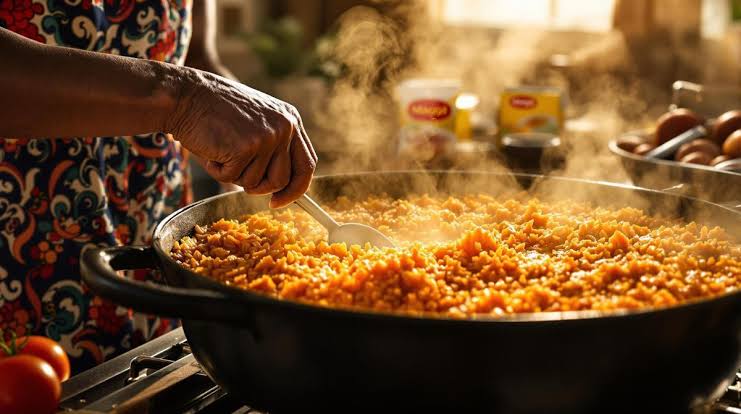
The cost of cooking a pot of jollof rice has surged to ₦25,486 in March 2025, a significant jump from ₦21,300 in September 2024.
This is according to SBM Intelligence’s ‘Jollof Index’ for Q4 2024 – Q1 2025.
The Jollof Index is a tool that gauges food inflation by tracking the cost of jollof rice ingredients across 13 markets in Nigeria, offering a relatable measure of household food affordability.
According to the report, “In September 2024, the average cost was ₦21,300, which increased to ₦25,486 by March 2025, representing a 19% rise. However, this increase was not consistent throughout the period, as the national average initially rose from October 2024, slightly decreased in January and February, and then resumed its upward trend in March 2025.”
SBM Intelligence linked the increase to rising prices of essential ingredients like rice, tomatoes, onions, pepper, turkey, and beef. Among these, protein remains the most unstable in terms of pricing.
“Protein, in particular, remains a major contributor to the overall cost, with turkey now costing between ₦8,000 and ₦10,500 per kilo, a substantial increase from the ₦1,500 to ₦1,700 it cost in 2016,” the report noted.
The study also cited broader macroeconomic issues such as high petrol prices and recent hikes in electricity tariffs for Band A users as contributors to increased food logistics and storage costs.
Security challenges in agricultural regions have further worsened the situation. “Insecurity continues to be a pressing concern, with incidents such as the killing of farmers in Benue, Borno and Plateau States disrupting agricultural activities and limiting the local food supply,” the report stated.
These attacks, the report says, have disrupted rural productivity and food supply chains, pushing up prices in urban markets where demand remains high.
Port Harcourt, Kano, and Bauchi experienced the sharpest spikes. In Port Harcourt, prices jumped by **55.1%**, rising from **₦20,400** in September 2024 to **₦31,650** by March 2025. This was attributed to political instability, inflation shocks, and supply chain disruptions in the South-South.
Kano followed with a **53.8%** increase from **₦19,020** to **₦29,250**, largely due to insecurity and escalating transportation costs. Bauchi saw a **34.9%** rise from **₦23,470** to **₦31,650**, which reflects continued pressure on northern food supply networks.
Other notable increases were reported across Nigeria:
– Lagos’ Trade Fair Market rose by **21.2%** (₦18,550 to ₦22,491)
– Calabar Municipal by **12.0%**
– Balogun Market by **9.2%**
– Awka by **11.4%**
“The Trade Fair Market in Lagos also saw a 21.2% rise (₦18,550 to ₦22,491), signalling persistent inflation in urban centres. In Calabar Municipal, prices climbed by 12.0%, while Balogun Market increased by 9.2%, and Awka rose by 11.4%, all pointing to region-specific supply disruptions and transportation challenges.”
In Abuja, the rise was more moderate:
– Wuse II increased by **7.8%** (₦28,300 to ₦30,500)
– Nyanya rose by **7.6%** (₦25,920 to ₦27,900)
“Although these increases are not as steep, they underline the ongoing decline in food affordability in Nigeria’s capital,” the report stated.
Interestingly, some areas experienced slight declines. Bodija Market in Ibadan recorded a **1.1%** drop (₦21,170 to ₦20,930), while Dugbe Market saw a **0.5%** decrease (₦21,670 to ₦21,560), likely due to better local harvests.
However, mid-tier traders in Lagos are reportedly absorbing high logistics and wholesale costs, pushing the burden onto consumers.
The report emphasised that food affordability gaps are widening in the Southwest, especially in Lagos, and called for urgent interventions to stabilise prices and streamline food distribution.
Despite government attempts—such as subsidised rice initiatives and food import duty waivers—the impact remains limited.
“Traders and analysts argue that streamlined import logistics, not government policy, are responsible for brief reprieves,” SBM reported.