By Segun Adeyanju
Entrepreneurship is often associated with wealth, innovation, intelligence, or charisma. Many people assume successful entrepreneurs are simply those with the best ideas or the largest financial backing. Yet decades of research and business experience suggest something far more important lies at the heart of entrepreneurial success: resilience.
Resilience is the ability to recover, adapt, persist, and continue moving forward despite failure, uncertainty, rejection, and pressure. From global technology founders to small business owners in developing economies, resilience consistently separates entrepreneurs who survive from those who quit.
Business history repeatedly shows that brilliant ideas alone do not guarantee success. Many talented entrepreneurs fail because they cannot withstand financial pressure, market rejection, criticism, economic instability, or repeated setbacks.
Research published in the Journal of Business Research found a strong positive relationship between entrepreneurial resilience and business success. Entrepreneurs who demonstrated resilience were significantly more likely to sustain and grow their ventures.
This explains why many successful entrepreneurs experienced failure before eventually succeeding. Steve Jobs was removed from the company he co founded before returning to transform Apple into one of the world’s most valuable companies. Jack Ma faced repeated job rejections before creating Alibaba. Oprah Winfrey overcame poverty and early career setbacks before becoming a global media figure.
Their experiences reveal a common trait: persistence under pressure.
A longitudinal study published in the Journal of Economic Psychology identified resilience as one of the strongest predictors of entrepreneurial success. Researchers highlighted hardiness, optimism, and resourcefulness as key resilience traits, with resourcefulness emerging as especially important.
This means successful entrepreneurs are not always those with the most resources, but those who can creatively use limited resources to solve problems and adapt to changing circumstances.
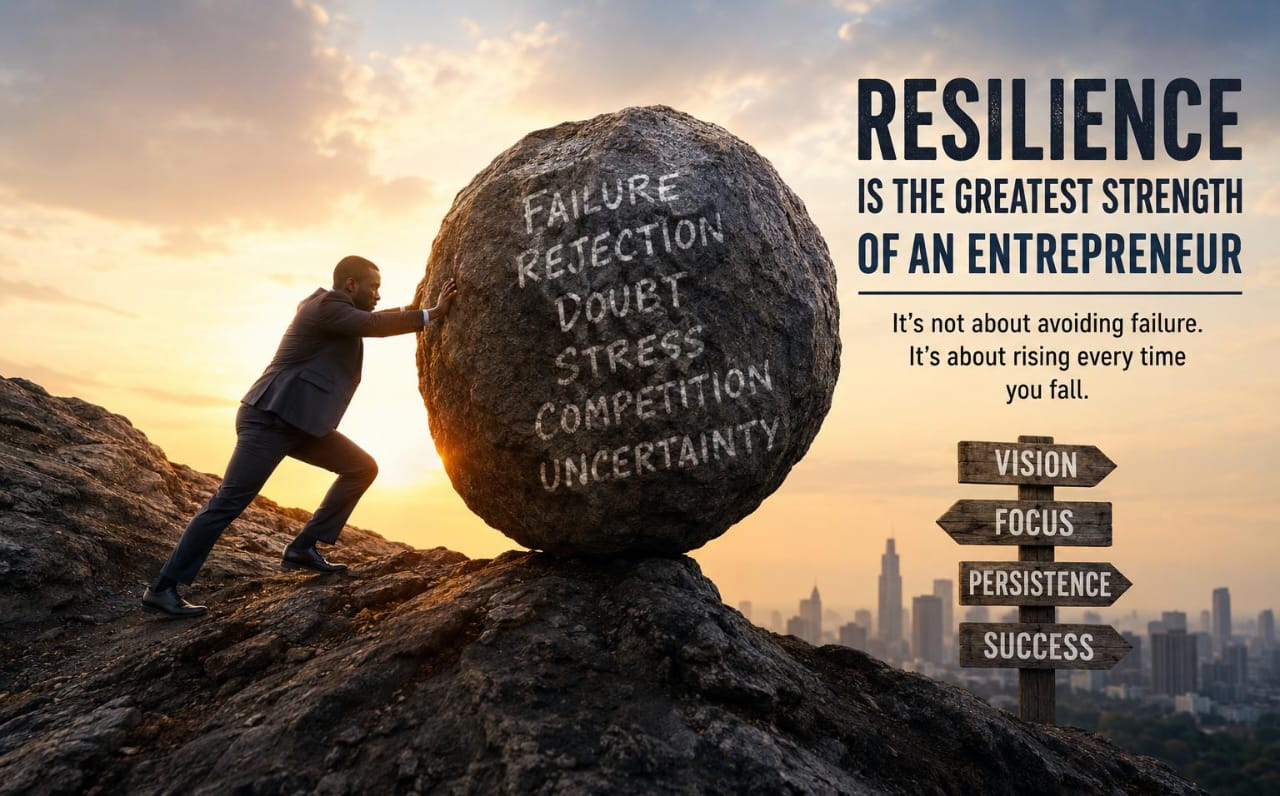
Entrepreneurship is also deeply psychological. Most business owners face uncertainty, emotional stress, competition, fear of failure, and cash flow difficulties. Research from the National Bureau of Economic Research found that successful entrepreneurs consistently demonstrate high self confidence, adaptability, persistence, and internal motivation.
Failure itself often becomes an advantage. Entrepreneurs who fail frequently gain experience, emotional endurance, stronger decision making abilities, and greater adaptability. A comparative study of Nigerian entrepreneurs found that serial entrepreneurs who had previously failed or exited ventures often showed stronger resilience and better long term business performance than first time founders.
Although resilience stands out as the greatest entrepreneurial strength, other qualities also matter. Vision helps entrepreneurs recognize opportunities others ignore. Adaptability allows businesses to survive changing markets. Communication enables entrepreneurs to persuade customers, investors, and employees. Emotional intelligence helps business owners manage stress and relationships effectively. Innovation drives creative problem solving.
Still, without resilience, these qualities often collapse under pressure. A visionary entrepreneur who gives up early rarely succeeds, while a creative entrepreneur who cannot survive setbacks may never see an idea grow into a successful enterprise.
In countries like Nigeria, resilience becomes even more important because entrepreneurs operate under difficult conditions including inflation, poor infrastructure, limited financing, unstable electricity, and insecurity. Many Nigerian entrepreneurs continue building businesses despite structural challenges that would discourage others. Their survival itself demonstrates resilience.
The greatest strength of an entrepreneur is therefore not wealth, popularity, or even intelligence. It is the ability to continue despite setbacks, uncertainty, and failure.
Research consistently shows that resilient entrepreneurs survive longer, adapt faster, recover better, and ultimately achieve greater success. In business, ideas may open the door, but resilience is what keeps entrepreneurs standing when challenges arrive.