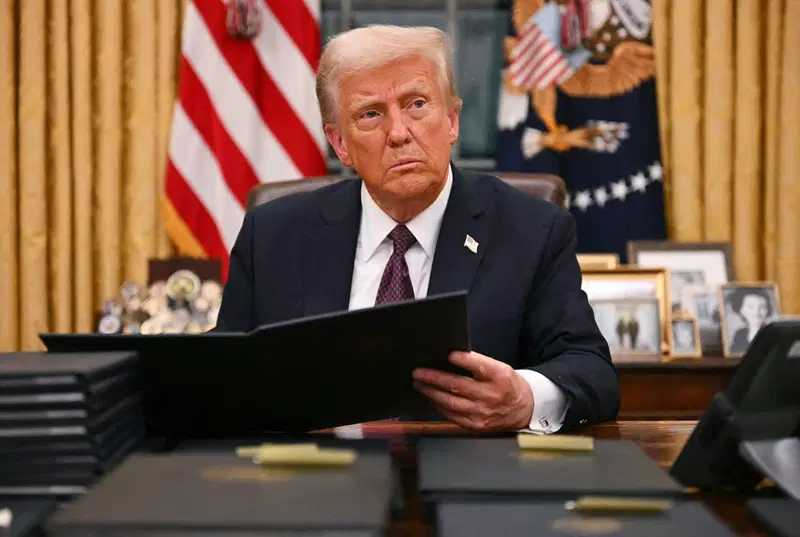
President Donald Trump on Saturday named English as the official language of the United States, saying it would bring coherence to a society marked by immigration from around the world. The White House issued an executive order by Trump stating that it is “long past time” that English be declared the nation’s official language.
“A nationally designated language is at the core of a unified and cohesive society, and the United States is strengthened by a citizenry that can freely exchange ideas in one shared language,” according to the agreement. The order revokes a presidential mandate from the 1990s under then-president Bill Clinton requiring federal agencies and entities receiving federal funding to give assistance to non-English speakers.
The agencies will continue to have the freedom to decide how much assistance to provide in languages other than English. The presidential order notes that it does not require or command any changes in agency services. It also states that agency heads have the authority to determine what is required “to fulfil their respective agencies’ mission and efficiently provide Government services to the American people.”
In his first weeks in office, Trump issued a slew of executive orders in an attempt to stamp his right-wing agenda on the country. However, many of his directives are being challenged in court, particularly when they seek to cancel federal funding approved by Congress.
While the White House acknowledges that more than 350 languages are spoken in the United States, the order states that English has been the nation’s language “from the founding of our Republic,” and that “our Nation’s historic governing documents, including the Declaration of Independence and the Constitution, have all been written in English.” According to US government estimates from 2019, about 68 million Americans speak a language other than English at home.
While English is by far the most common language in the country, more than 40 million Americans are estimated to speak Spanish at home. In addition to other immigrant groups such as Chinese and Vietnamese, the complex US linguistic landscape contains a large number of Native American languages.