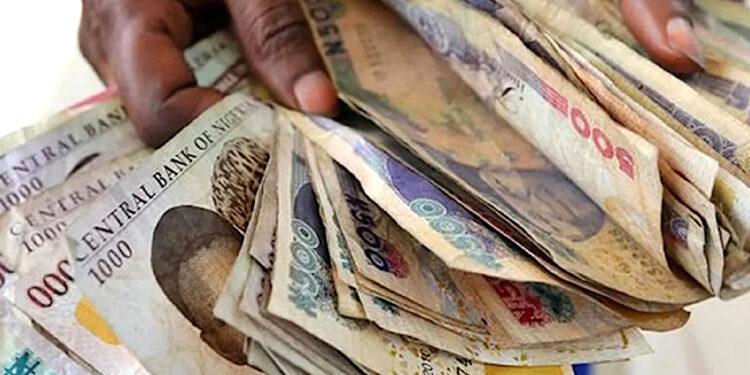
Recent data from the Central Bank of Nigeria (CBN) reveals that the currency in circulation (CIC) reached a historic high of ₦4.05 trillion in June 2024, marking a 56% increase from ₦2.6 trillion recorded in the same month the previous year.
The CIC includes currency outside the banking system and the cash held in bank vaults. This milestone is the first time Nigeria’s currency in circulation has exceeded ₦4 trillion, according to the CBN.
Month-over-month, the currency in circulation grew by 2%, rising from ₦3.65 trillion in May 2024.
Further analysis by Nairametrics shows that 94% of the currency in circulation is outside the banking system, with cash outside banks reaching a new high of ₦3.79 trillion. The amount of currency outside banks has more than quadrupled over the past year.
Insights from the Data
In January 2024, Nigeria’s currency in circulation was ₦3.65 trillion, a 163% increase from ₦1.39 trillion in January 2023. This reflects an astonishing year-on-year growth of 163.3%. Currency outside banks showed a similar trend, increasing by 314% from ₦792.18 billion in January 2023 to ₦3.28 trillion in January 2024.
The upward trend continued in February 2024, with currency in circulation rising by 276% to ₦3.69 trillion, compared to ₦982.1 billion in February 2023. Currency outside banks also grew substantially, reaching ₦3.41 trillion, up from ₦843.31 billion the previous year, a 304.7% increase.
In March 2024, the currency in circulation increased to ₦3.87 trillion, up from ₦1.68 trillion in March 2023, reflecting a year-on-year growth of 129.8%. Currency outside banks rose to ₦3.63 trillion from ₦1.45 trillion in March 2023, marking a 151.1% increase.
April 2024 saw the currency in circulation reach ₦3.92 trillion, compared to ₦2.38 trillion in April 2023, a 64.9% year-on-year increase. Currency outside banks also rose to ₦3.61 trillion from ₦2.08 trillion the previous year, a 73.4% growth.
The trend continued in May 2024, with the currency in circulation hitting ₦3.97 trillion, a 56.9% increase from ₦2.53 trillion the previous year. Currency outside banks rose to ₦3.71 trillion from ₦2.18 trillion in May 2023, representing a 70.4% increase.
June 2024 marked a historic moment as the currency in circulation exceeded ₦4 trillion for the first time, reaching ₦4.05 trillion. Currency outside banks also climbed to a new high of ₦3.79 trillion, up from ₦2.26 trillion in June 2023, representing a 67.5% increase. The data for June indicates continued growth in liquidity and a preference for holding cash outside banks.
Key Considerations
The high percentage of cash hoarding could be due to several factors, including a lack of trust in the banking system, concerns about inflation, and a preference for liquid cash for daily transactions.
This surge in currency circulation could have both positive and negative economic effects. On the positive side, increased cash circulation may signal heightened economic activity and consumer spending. However, it also raises concerns about inflationary pressures, as more cash in the economy can lead to higher prices for goods and services.
This growth occurs amid the Monetary Policy Committee’s (MPC) stringent measures to control inflation.
In June 2024, the headline inflation rate increased to 34.19%, up from 33.95% in May 2024, and was 11.40 percentage points higher than the 22.79% recorded in June 2023.
On a month-on-month basis, the headline inflation rate in June 2024 was 2.31%, a 0.17 percentage point increase from May 2024’s rate of 2.14%.
Nigeria, which has been dealing with inflationary pressures, may face further inflation increases if the growth in money supply is not accompanied by a corresponding increase in production. This could erode purchasing power and affect the cost of living, especially for lower-income households.